Orchestrate tenant overlay configuration across all sites from centralized MSD fabric.
Deploy VRFs and networks from the MSD fabric to all member sites simultaneously. MSD automatically handles VNI consistency, route targets, and inter-site routing configuration across border gateways.
Extend tenant VRFs and networks across sites seamlessly, enabling workload mobility and distributed applications. MSD ensures consistent configuration and automated inter-site route distribution.
By managing overlay at the MSD level, adding new sites or extending tenants becomes a simple operation that MSD orchestrates across all member fabrics, reducing operational complexity.
In your Multi-Cluster fabric, navigate to Networks to attach your BlueNet1 Network to Site2-L1.
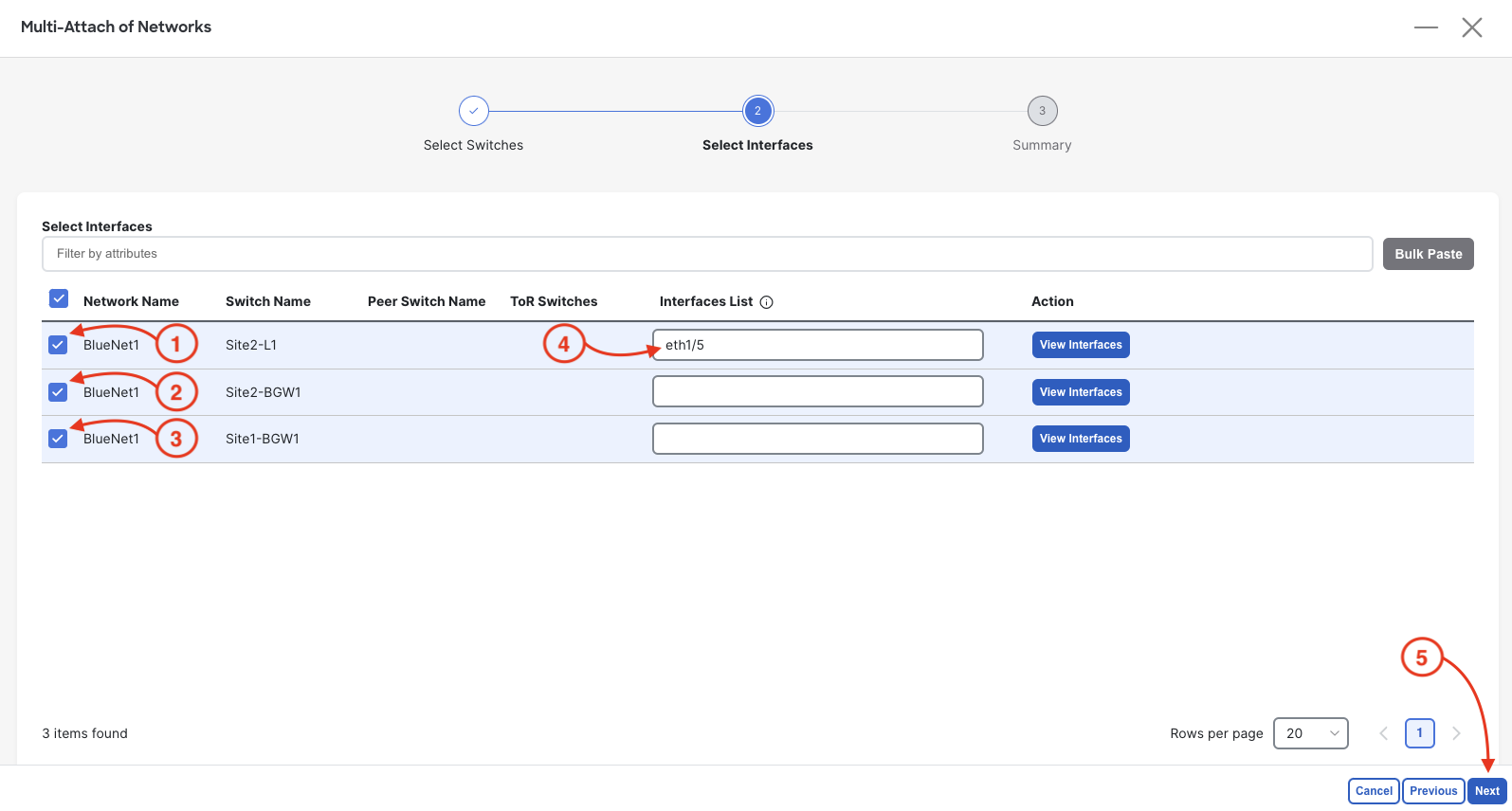
Review the configuration to be deployed, then:
Review and confirm your BlueNet1 network is attached to all your leaf swithces except for your Site1-BL. This attachment and deployment has extended this VXLAN EVPN L2VNI segements across your Site1 and Site2 fabrics.
Navigate to VRFs where you can now check your VRF Attachments to confirm that your L3VNI, BlueVRF, originally created in your Site1 fabric, has also been extended.
The MSD fabric Overview dashboard has not changed all that much, but it has updated the Extended Networks/VRFs area of the dashboard, which is infact the most import change. There are now two (2) extended networks and three(3) extended VRFs. You will need to wait 300 seconds for the NVE interface's delay-restore timer for the loopback to come up and display in the dashboard.